🌬️ A change in the air
I can sleep better this year, because there are fewer air raid alerts. And yet, the war continues and changes to become ever more violent elsewhere.


Attacks from the air
Last year, I described how studying in war means broken sleep every other night — due to air raid alerts. This year has been rather different so far. Since I entered Ukraine on the 7th of June until the 20th, I've only had air alerts a few times:
- on Monday the 8th for 40 minutes (14:15 - 14:55)
- on Thursday the 11th for 7 minutes (23:36 to 23:43)
- on Saturday the 20th for 23 minutes (18:32 to 18:55)
I don't know what the reason for this calm was. I‘m jinxing it though, because in the night of the 21st I’ve already had two alerts. (I’m editing this post at 03:50, mere hours before publication, to avoid misinforming you.)
The relatively long calm in Lviv doesn't mean the attacks on Ukraine have stopped, though...
Attack on a church in Lviv
On the 24th of March, russia attacked Lviv in broad daylight with a shahed, hitting the St. Andrew's Church. Some church windows were broken, but luckily the interior was mostly spared.
One of the staff members at the UCU told me that she'd been exactly at the place that was hit just 15 to 30 minutes earlier. And she admitted she had gotten so used to the rarity of attacks on Lviv she dismissed the air alerts in her mind before, so this was a wake-up call again.
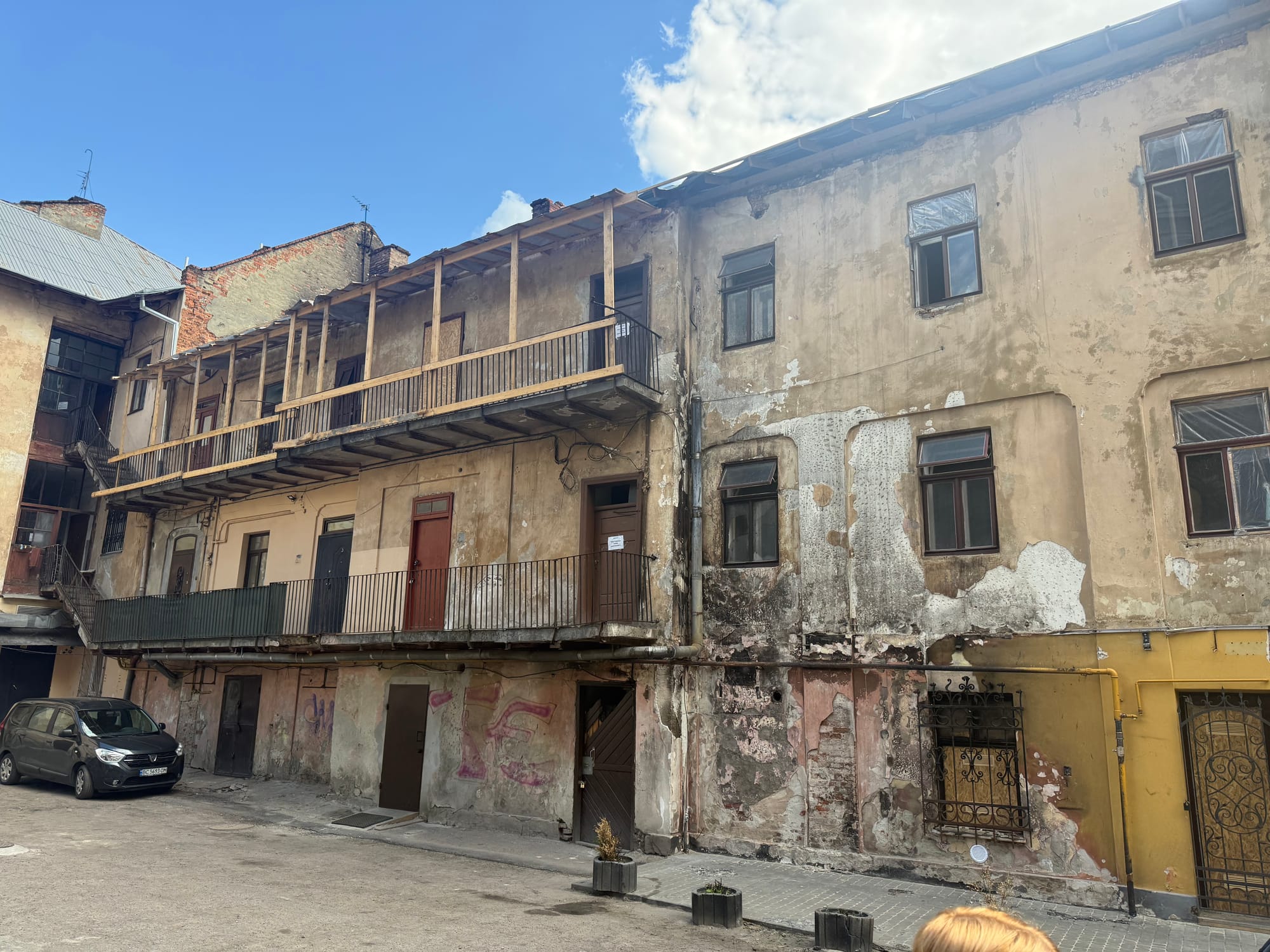

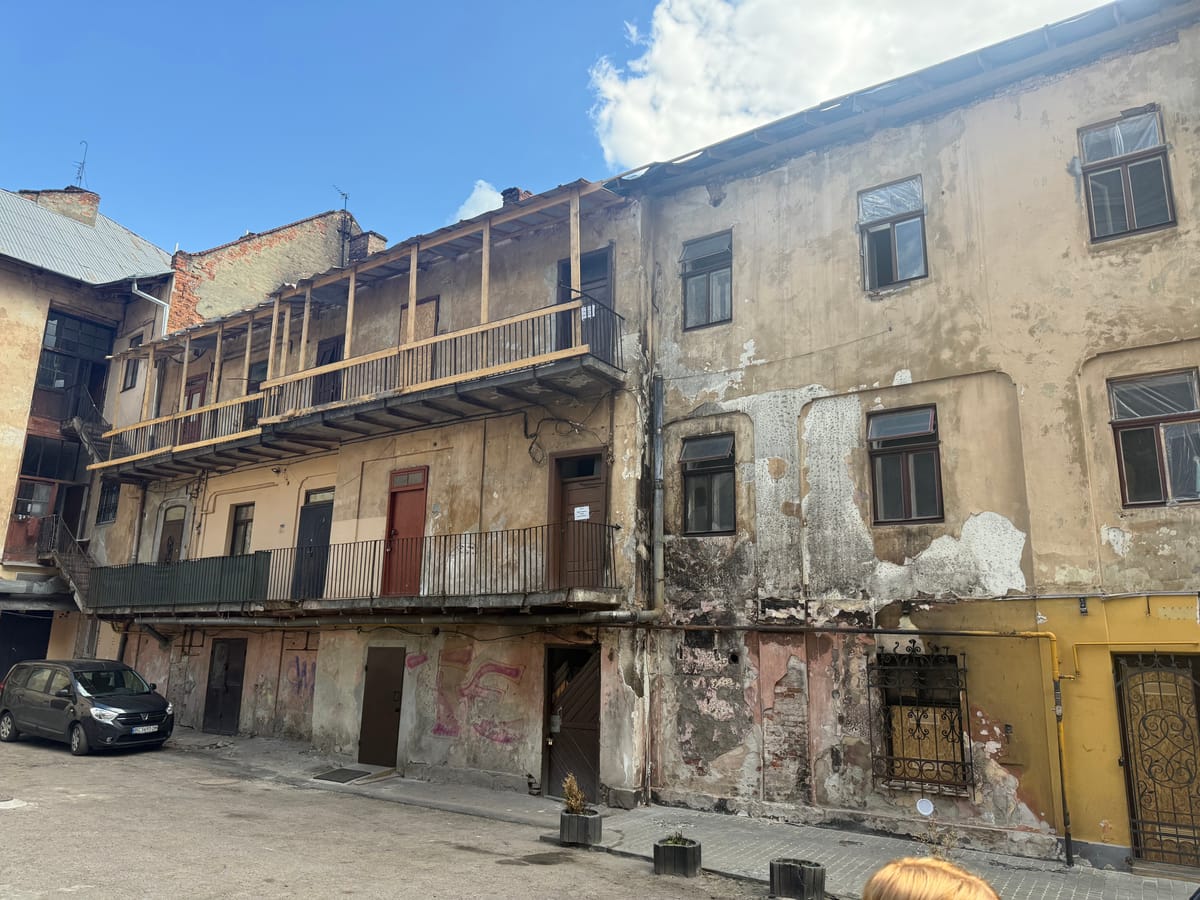
What I saw in the city center, near St. Andrew's Church
Attack on a monastery in Kyiv
The russians attacked Kyiv in the night between the 14th and 15th of June. The attack on the capital killed at least five people, and injured 35 more.
The attack set the Dormition Cathedral in an 11th-century monastery on fire: the Lavra. This UNESCO World Heritage site is like Ukraine's Notre-Dame and was founded in Kyivan Rus' times, predating even Moscow.
The cultural value of this site must be known to russia — and was probably attacked for that very reason. Destroy evidence of Kyivan Rus' in Ukraine, and thereby undercut Ukraine's claim to the Rus' legacy and an independent state. Or perhaps it's purely to inflict terror and despair in Ukraine, although russia must have learned by now that Ukrainians don't bend to russia.
Of course, if you ask the russians, they blame Ukraine's faulty air defences. It's always surprising how well they know the technical conditions of Ukraine's military installations, and how gracefully they decide to leave those installations intact.
Kyiv Pechersk Lavra attacked on the night between the 14th and 15th of June
Attack on statues
The disrespect by russia for religious objects is not new. Co-student Daan reports:
During the Soviet occupation of Ukraine it was common that russians removed almost all statues from public spaces which had a religious connotation.
To prevent any protests or other forms of civil unrest, statues simply disappeared during the night.
This was also the case for the Maria statue which had a prominent place in the city center of Lviv. A couple of days after its disappearance, a family found the statue in a bin or container. They decided to take the statue home and hid it in their cellar.
The statue stayed with the family for almost fifty years. They kept it hidden until two years after Ukraine's independence — to be sure that the russian occupation was not going to come back.
The statue was placed in the St. Andrew's Church — the very church in Lviv that was attacked in March. The statue stands as a memory of a courageous act of resistance against destruction of these symbols.

Attacking russia
Ukraine is not merely defending against this onslaught by russia; they are hitting back. In fact, in Western media there's a lot of talk of changing momentum in the war — in Ukraine's favour — with advances in drone technology and production.
You might expect Ukrainians to enjoy these developments. In general, most seem to reserve judgement. They have been betrayed by optimism before so they mostly have an attitude of "wait and see". They do not underestimate the "orcs" (russians, as Ukraine names them sometimes) or their yearning for conquest.
Having said that, the attack by Ukraine on Moscow on the 18th of June seemed to uplift some moods a bit. The attack videos were going viral on Ukrainian feeds quickly. One Ukrainian described it as permitting herself to feel a bit of hope again after a year of mentally bracing herself for the worst.
After russia's targeted attacks on churches, hospitals, apartments, schools, playgrounds and more, seeing black clouds and oil tank lids flying over Moscow just feels comparatively elegant and symbolic. I say comparatively because I expect there's always collateral damage and human suffering. I say elegant and symbolic because Ukraine shows it answers russia's war crimes with continued targeting of russia's oil infrastructure — rather than an eye-for-an-eye tit-for-tat revenge.
Attack on Moscow on the 18th of June
Next attacks?
It is clear a lot has changed since last year. Momentum is shifting, weapons are changing, people are adapting. We'll have to see what the war brings next. The end is not yet in sight, but I do hope next year I may return by airplane.